Opensource semantic layer
built for agents.
Define your metrics once. Query them from any agent, app, or script — correctly, every time.
Built for agents, not dashboards
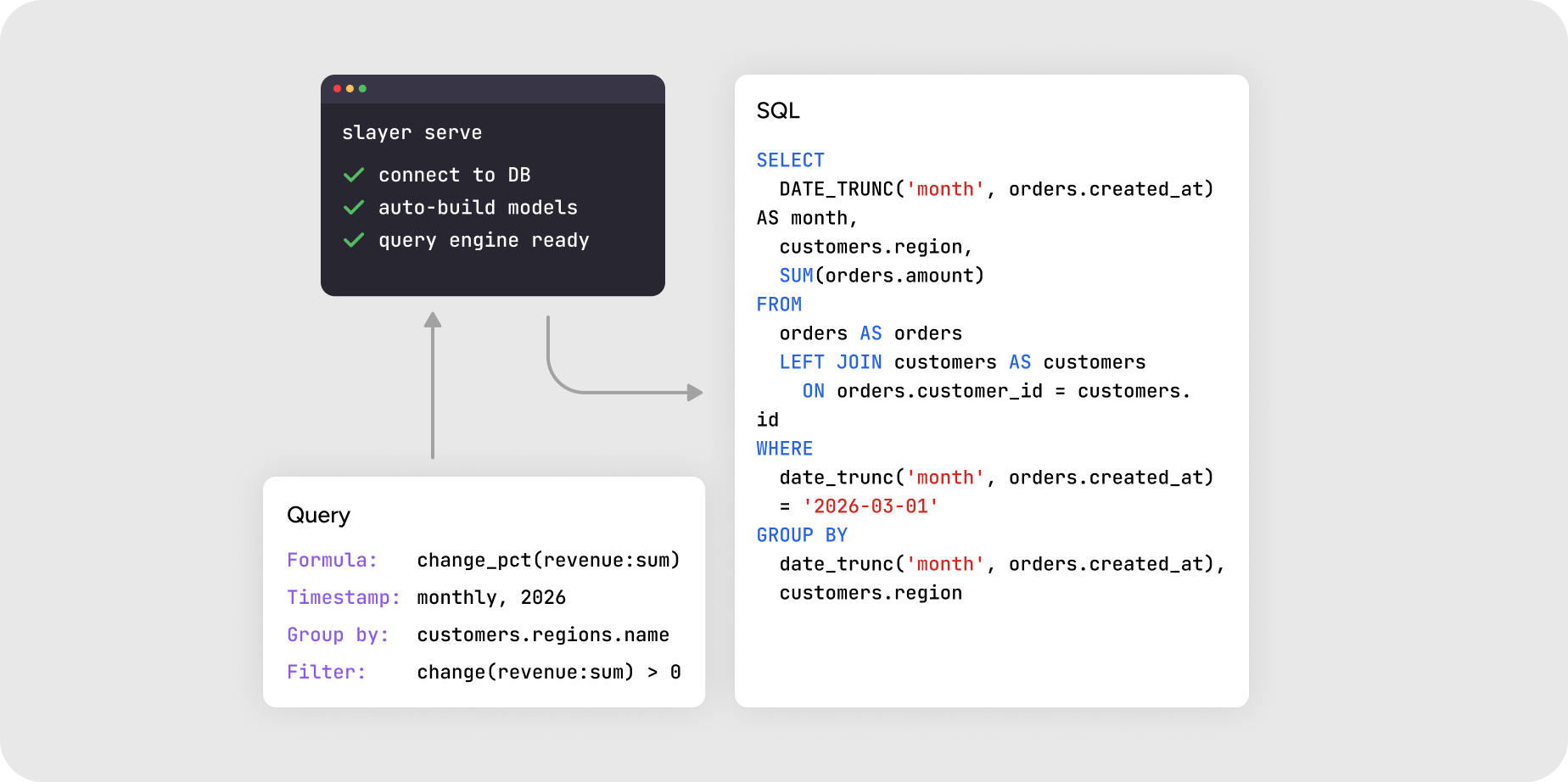
Most semantic layers were built for BI tools and static dashboards. SLayer is built for AI agents that need dynamic, predictable, and structured access to analytics logic.
SLayer provides a simple semantic interface that allows LLMs to generate queries in a natural way while remaining powerful enough for real analytics logic.
Instead of generating fragile SQL, agents query a structured representation of metrics, dimensions, joins, and time logic.
SLayer also doesn't spam your agent's context - skills are available on-demand via the help() tool.
This makes queries more reliable, reusable, and easier to reason about.

Define once. Query anywhere.

Connect Your Data

SLayer introspects your schema and creates semantic models automatically.
Foreign keys become joins.
Columns become measures and dimensions.
Models are queryable immediately.

Adjust models dynamically
Update models instantly through YAML or API without rebuilds or compilation steps.
Fast iteration for agent workflows and changing schemas.

Query via structured interfaces
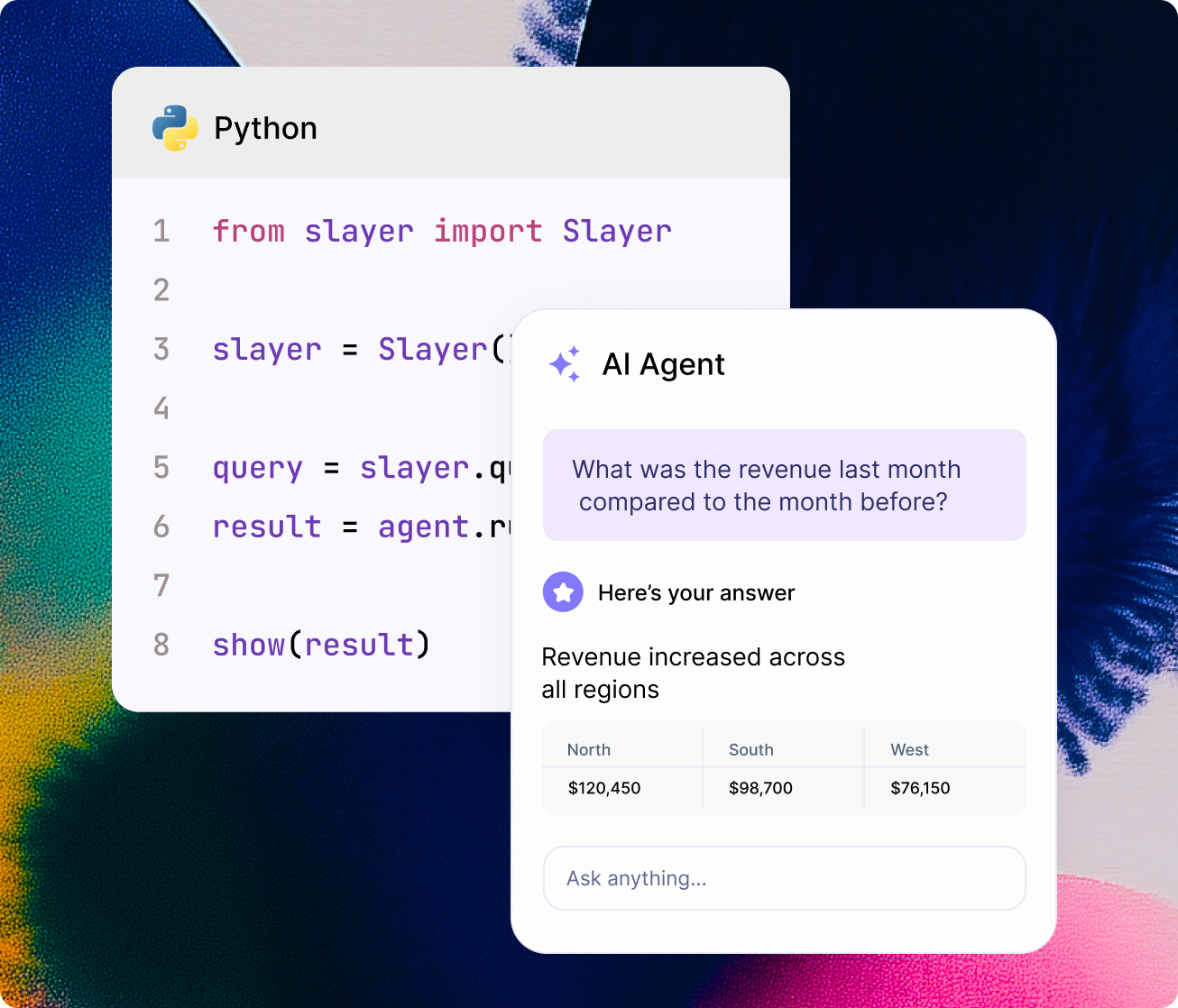
Use the same semantic definition across every workflow — through MCP, Python, HTTP REST API, or CLI.
One semantic contract, accessible from agents, apps, scripts, and developer tools.
Why developers choose SLayer

Agent-native structure
Designed for workflows where queries are generated dynamically by AI tools rather than predefined manually.
SLayer gives agents a constrained, structured query interface designed for reliability, reproducibility, and easier reasoning compared with raw SQL.

Powerful query layer
Supports query-time transformations such as time_shift, diff, and dynamic aggregations.
Complex analytical queries can be expressed through structured semantic operations without complex SQL window functions.
.jpg)
Lightweight and standalone
Runs locally, embedded, or as a service
No dbt project required
No BI platform dependency
No heavy infrastructure

Fast model generation
Database schemas can be converted into semantic models automatically, including relationships between tables.
New and modified models are available instantly, so agents can use updated analytics logic without waiting for manual deployment.
Reduces manual modeling work significantly.
.png)
Python-native ecosystem fit
Integrates naturally into Python-based data and agent workflows.
Works as a library, CLI tool, MCP server, or API.
Designed for modern data workflows
SLayer works best in environments where queries are generated dynamically and reused across tools.
Common use cases

AI-powered reporting
agent-driven analytics
internal developer platforms
embedded analytics
notebook workflows
SLayer acts as a reusable semantic contract between data and the systems that consume it.
Works across SQL databases
Start building with an agent-native semantic layer
.png)